


Pre-Engineered Building Structures (PEBs) - What are they, and why are they popular?
Summary:
If you are involved in modern building construction today, you must have come across the term "Pre-Engineered Building Structures," sometimes abbreviated as "PEBs". But what are they, and why are they increasingly becoming popular today? In this article, we explore what a Pre-Engineered Building is, what materials it is made of, why clients prefer it today, and what its common applications are.
What is a Pre-Engineered Building (PEB)?
Construction project success today is generally evaluated on the basis of 5 core parameters: Time , Cost, Quality, Safety, and Environment. As they say, time is money and money supply is limited. As such, a construction engineer must constantly evaluate and adopt the most efficient construction methods and materials to achieve the best project results on time and within the planned cost while simultaneously ensuring the project meets approved standards with minimal site accidents and minimal negative effects on the environment. PEBs have been popularized to solve these challenges.
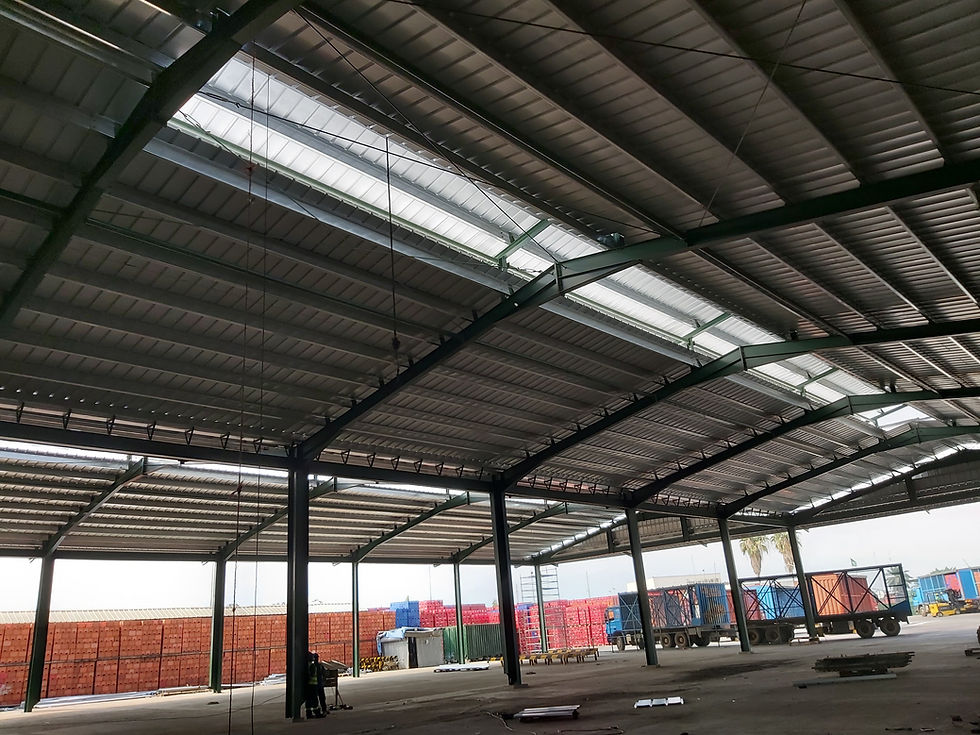
A Pre-Engineered Building (PEB) is an engineering structure whose structural components are designed and fabricated offsite, then shipped to site prefabricated ready for rapid assembly. Unlike conventional construction, where building materials are procured first, supplied to site and then built in situ, PEBs are delivered to site ready-to-assemble which saves a lot of time and money.
What materials are Pre-Engineered Buildings commonly made with?
Due to the prefabricated nature of PEBs, it calls for materials that are flexible to design and easy to transport (not bulky). Due to its non bulky nature, coupled with its superior strength-to-weight ratio, steel is the most ideal choice for PEB construction. Compared to concrete for instance, steel requires a much smaller volume / self weight to support the same load (especially under tensile and shear forces).
Tensile loads act by stretching structural elements apart, whereas shear loads act by causing adjacent structural elements to slide against each other in opposite directions. A classic example of a tensile loaded element on a building is a roof truss tie beam / tie rod i.e the horizontal member at the bottom of the roof truss triangle that is pulled outward by the weight of the roof, putting it in tension. A classic example of shear loads on a building are wind and earthquakes which act by causing structural elements on a building to slide against each other.
Why are PEBs popular today?
PEBs are very popular today owing to several advantages, key among which are:
Speed of Construction. Because PEB components are prefabricated off-site, on-site assembly (usually by bolting) is significantly faster than conventional site construction. By rapidly assembling the prefabricated components on-site, operations can begin sooner and generate revenue faster.
Cost-Effectiveness. Precise workshop fabrication associated with PEBs minimize material wastage and labor costs during construction. Also their prefabricated nature means that significantly less ancillary materials such as formwork are required on site.
Retrofitability. PEBs can be easily expanded or retrofitted with structural systems like mezzanine floors and crane runway beams making them popular choices in industrial establishments that require constant retrofitability and scalability.
Flexibility in Design. Often referred to as the ‘lego blocks’ of the construction industry, PEBs can be easily molded, adapted, and reconfigured to suit different project design needs especially when factory floors that require long spans without intermediate columns.
Precision Construction. PEBs are manufactured from the factory (prefabrication workshops) using precision machinery such as Computer Numerical Control (CNC) machines. This helps eliminate the human errors that are associated with manual site fabrication and hence ensures consistency in the quality of the works.
Strength and Durability. PEB Steel structures offer a better strength-to-weight ratio compared to their Reinforced Concrete (RC) counterparts especially under tensile and shear loads. As a result, PEB Steel structures are very popular for factory buildings and in areas susceptible to seismic loads.
Limited Safety Incidents on site. Every building component fabricated offsite (as is the case with PEBs) means less site labour, less site materials and less site construction equipment and tools, all of which would have rendered the site congested, increased site obstructions and the susceptibility of the site to safety accidents.
Reduced Site Waste. The prefabricated nature of PEBs means that the majority of the resultant waste such as steel offcuts, paint chemicals, etc. (that would have otherwise piled up on site) is left at the factory (fabrication workshop) where it can be better recycled & managed in a controlled environment leading to better environmental sustainability.
Limited Environmental Pollution. On-site construction generates significant sound and air pollution in the form of noise and dust from construction operations such as cutting, grinding, welding, painting, etc. All this environmental pollution is avoided when you use PEBs. This is why PEB construction is increasingly becoming popular in urban construction settings where the need to limit noise and dust pollution is paramount.
Optimum Space Utilization. PEBs are very popular on projects / sites where the available space for construction operations is limited such as busy manufacturing facilities . With PEBs, all the structural components are fabricated off-site and only brought to the site for quick assembly & erection.
Common Applications of PEBs?
Since PEBs are predominantly made out of steel, and steel is ideal for tensile and shear loaded structures, PEBs are popularly used in tensile loaded structures such as;
Roof Trusses,
Industrial Pipe Bridges & Platforms,
Bridges & Overpasses including weighbridges, pedestrian bridges, etc.
PEBs are also the most feasible option for shear loaded structures such as;
High-Rise Office Buildings,
Structures in earthquake prone areas, among others.
Due to their prefabricated nature, ease of assembly, disassembly and retrofitability, PEBs are commonly used on most industrial projects for;
Industrial Cold Rooms,
Production Warehouses,
Industrial Processing Units,
Other key common applications of PEBs include:
Fuel Stations,
Poultry Houses,
Airport Hangars,
Commercial Buildings,
Gyms & Fitness Centres,
Military and Mining Sites,
Agro-processing Facilities,
Retail Stores & Showrooms,
Business and Industrial Parks,
Student Halls & Public Libraries,
Sports Arenas and Training Facilities,
Logistics Hubs & Distribution Centers,
Mechanical Workshops and Service Centers,
Contractor Site Offices and Temporary Shelters, among others.
Deub Engineering Solutions offers custom Pre-engineered Building (PEB) solutions focusing on exceptional designs, quality workmanship, timely delivery and at an affordable price.

We design, fabricate, supply & install all the above PEB structures and many across East Africa. For more details, please reach out to us on WhatsApp: https://wa.me/256780328941 or via our website: https://www.deubeng.com
Thank you.
Comments